Blockchain Notes
First rule: Before using machine learning or blockchain, determine if you can implement the solution without them.
Open properties of public blockchains: A blockchain is more than open source — it provides open state and open execution. Everyone can read the database and replay opcodes (on public chains). Anyone holding coins can submit transactions on permissionless chains. Anyone with appropriate consensus participation (compute, stake, or permission) can propose or write blocks depending on the chain design.
Use a database where decentralization is not required. Design token economics carefully — tokens fund security and incentives. Be pragmatic: decentralization and trustlessness are design choices, not absolutes.
🦾 tl;dr
Once overshadowed by AI’s meteoric rise, the blockchain sector is entering renewed innovation. Blockchains introduce programmable digital scarcity, an economic primitive not natively provided by traditional internet protocols.
| Theme | Description |
|---|---|
| Market Conditions | Market volatility and heightened skepticism. |
| Blockchain Progress | Blockchain continues to evolve and shows notable progress. |
| Regulatory Clarity & Investment | Growing institutional interest and clearer regulatory frameworks in some jurisdictions have supported development. |
| Technological Advancements | Improvements in scaling, privacy, and interoperability. |
| Real-World Impact | Use cases expanding beyond finance into identity, supply chain, and decentralized governance. |
In details:
Blockchain progress
The future of blockchain extends beyond payments — it aims to be a foundational layer for digital trust across many sectors. Upcoming infrastructure areas: identity, DNS alternatives, decentralized storage, and hosting on-chain or via interoperable networks.
Regulatory Clarity and Financial Investment
Investments: Major financial institutions have poured substantial capital into blockchain, recognizing its value far beyond cryptocurrencies. One notable development is BlackRock’s ETF acquiring blockchain municipal bonds, signaling deeper integration of blockchain technology into traditional finance.
Regulation: Regulatory clarity has improved significantly. The U.S. SEC’s approval of spot Bitcoin ETFs exemplifies a cautious yet positive shift in how regulatory bodies approach blockchain-based assets.
Technological Advancements
Scalability and Interoperability: Layer-2 solutions such as Arbitrum and Optimism have improved transaction speed and lowered costs. Meanwhile, interoperability frameworks like Polkadot and Cosmos are successfully connecting once-isolated blockchain ecosystems.
Privacy and Security: Zero-knowledge proofs and secure multi-party computation technologies are enhancing privacy and security. These advancements support new applications—from private AI training to enterprise-grade secure systems.
Real-World Impact
Stablecoins: As noted in your article, stablecoins are reshaping global payment systems by delivering near-instant, low-cost transactions. Their rise could significantly reduce global reliance on traditional banking for cross-border transfers.
Industry Applications: Blockchain is expanding its reach across multiple industries. Supply chain management, healthcare, and identity verification are experiencing tangible benefits. Emerging initiatives like Sophon’s mainnet are even pioneering on-chain entertainment, hinting at new cultural and economic models.
⁉️ What is blockchain?
A blockchain is a distributed system for recording and verifying data across a network without requiring a central authority. It introduced programmable digital scarcity, an economic primitive not natively provided by traditional internet protocols.
I. Defining Blockchain: a technology with many faces:
- A distributed ledger replicated across peer-to-peer nodes.
- Can be public (permissionless) or private/consortium (permissioned).
- May include a native token, depending on design.
II. How a blockchain works:
- Users submit transactions to the network.
- Nodes verify and order transactions.
- Blocks or similar data structures are added through a consensus process.
- Some blockchains support smart contracts that run deterministically on-chain.

III. Consensus mechanisms: includes Proof of Work (PoW), Proof of Stake (PoS), Delegated PoS, and Byzantine Fault Tolerant (BFT) variants, each with trade-offs in security, scalability, and decentralization.

DeFi is evolving beyond monolithic blockchains. Traditional chains bottleneck at tens–hundreds TPS, while Tier-1 FX handles millions. DAGs + zkVMs + offchain sequencing → finality <100ms, deterministic MEV, chain-agnostic composability. Sequencing is moving upstream.
IV. Applications: used for payments, tokenization, DeFi, identity management, supply chains, provenance tracking, DAOs, digital content platforms, and other decentralized systems.
⛓️ Concise notes & claims
🔹 Code modules (smart contracts) on blockchains have unique addresses and can receive payments for execution.
🔹 If you do not require true decentralization, a blockchain may be unnecessary.
🔹 Blockchains record global precedence records and reduce reliance on centralized certifiers for some digital ownership models.
🔹 Market networks built on blockchains can challenge traditional centralized systems over time.
🔹 Merit on a blockchain can represent security, computation, prediction, attention, bandwidth, or storage.
🔹 Token inflation is often used to fund ongoing development and participation incentives.
🔹 Transparency is not unique to blockchains — immutability of pointers or logs can be implemented in other systems.
🔹 Blockchains enable programmable digital scarcity via cryptographic tokens and NFTs.
🔹 Spam resistance is achieved through transaction costs, but it depends on fee design and network economics.
🔹 Long-term, trust-critical applications rely on stable economic and technical foundations (stablecoins, long-lived mainnets).
🔹 Communities and active governance are crucial for the success of many blockchain projects.
🔹 Decentralization exists on a spectrum — "absolute" decentralization is rare and often impractical.
🔹 dApps can inherit security properties from their underlying chain and compose with other on-chain systems when interfaces are standardised.
🔹 Blockchain engineering is globally accessible; developers and contributors can work from anywhere.
⚙️ Blockchain Platform Functional Framework
| High-level components found in many blockchain platforms: | |
| Components | Components, Smart Contracts (on-chain code), Trusted Runtime Execution & APIs, Nodes, Accounts, Key Management, PrivacyCoordination Protocol, On-Chain Data, Platform EconomyInteroperability, Governance Automation, On-chain Scalability Infrastructure: P2P, Messaging, Cryptography, Events |
|---|---|
| Technology Stack: from application layer to infrastructure: | |
| Layer | Description |
| Application Layer | dApps, browsers, hosting, programming languages |
| Services | Oracles, wallets, state channels, DAOs, governance tools |
| Protocol Layer | Consensus algorithms, L1/L2, EVMs |
| Network Layer | P2P transport, block delivery, TEE, relays |
| Infrastructure Layer | Nodes, mining/validators, tokens, storage |
⚙️ Blockchain developer Roadmap
Suggested learning path for blockchain developers (practical, project-first approach):
L1: Blockchain basics
L2: Git & Github
L3: HTML & CSS
L4: CSS framework
L5: Typescript/Javascript
L6: React
L7: Node.js
L8: web3.js/Ether.js
L9: Solidity
Ship projects after L3. Practical experience matters.
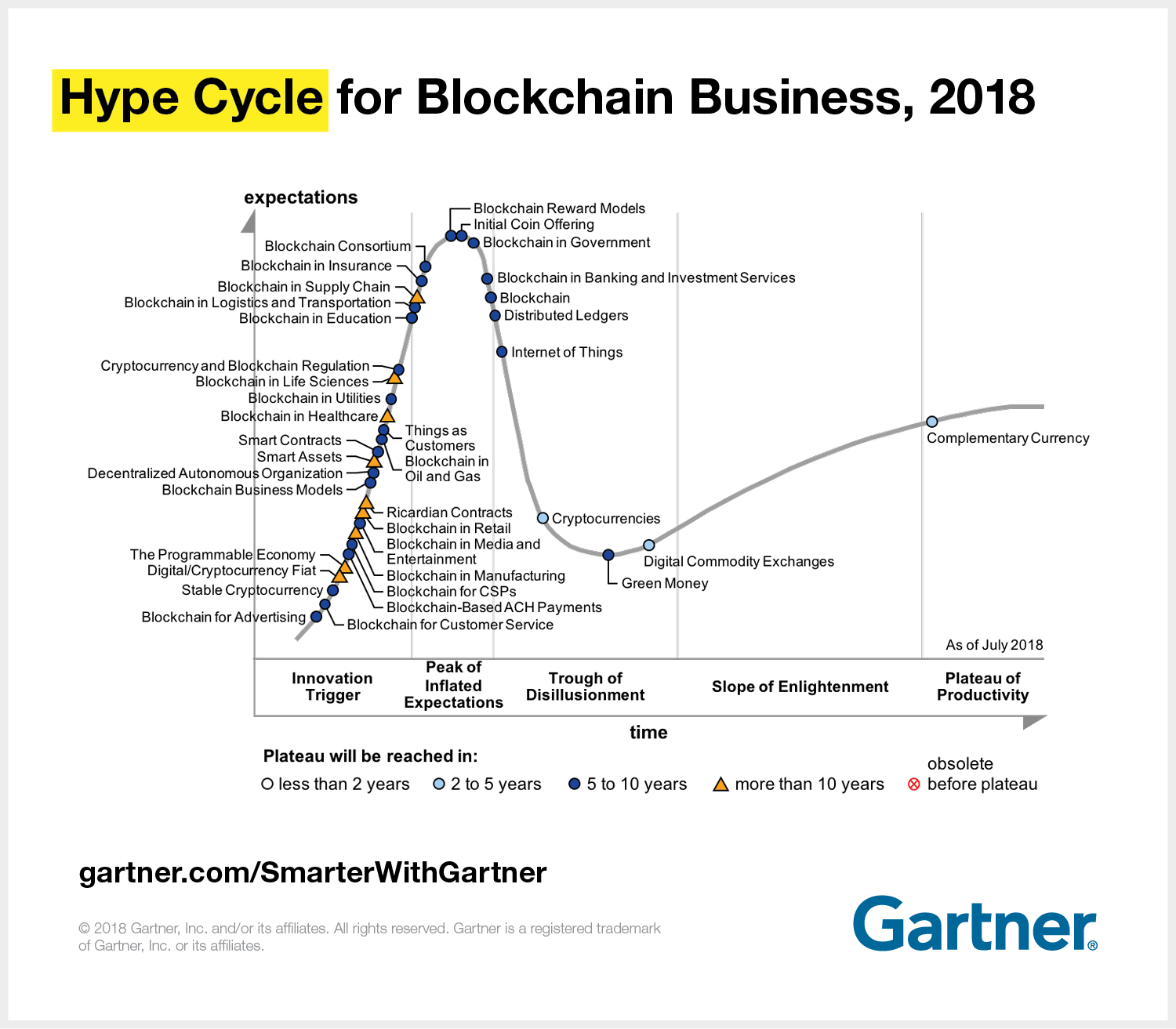
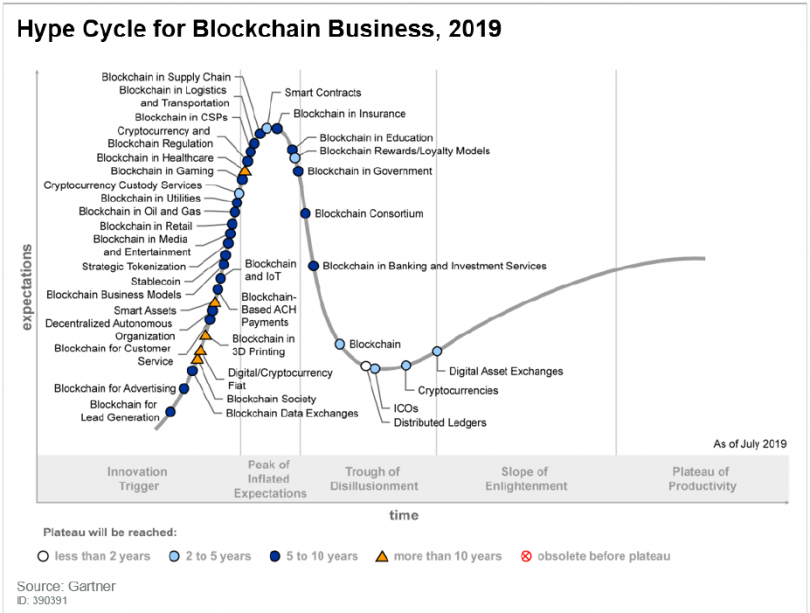
🧮 Hype cycle for Blockchain
Hype Cycle for Blockchain 2018
Hype Cycle for Blockchain 2019
Hype Cycle for Blockchain 2020
Hype Cycle for Blockchain 2021
Hype Cycle for Blockchain 2022


📚 Free eBook
Free Blockchain's eBook by Melanie Swan (O'Reilly, 3.4 Mo, PDF Format)
