Sir Tim Berners-Lee
On December 10th, 2018, 50% of the world will have access to the Internet on the 70th Anniversary of the Universal Declaration of Human Rights by the United Nations.
In 1989, Oxford alumni Tim Berners-Lee invented the World Wide Web, hoping for its use to engender a more egalitarian society and provide individuals with the means of expression.
Berners-Lee has become one of the most celebrated computer scientists of all time. Named as one of the 100 most important people of the 20th century by Time Magazine in 1999, made a fellow of the Royal Society in 2001, Knighted in 2004, added to the Order of Merit in 2007 and winning the 2016 Turing Award - generally considered to be the highest distinction in computer science. He featured in the opening ceremony of the London Olympics in 2012, and has honorary degrees from many universities, including Harvard and Yale. He currently holds Professorial posts at the University of Oxford and MIT.
Berners-Lee continues to be one of the most prominent advocates around the world for a free and open internet, and co-founded the Open Data Institute in 2012.
Quotes by Sir Tim Berners-Lee
Do you know why you won't find any mention anywhere on the W3C website of #web3? It does not exist. BOOM! There is one web (W3C)
We need diversity of thought in the world to face the new challenges.
The original idea of the web was that it should be a collaborative space where you can communicate through sharing information.
The Web as I envisaged it, we have not seen it yet. The future is still so much bigger than the past.
There was a time when people felt the internet was another world, but now people realise it's a tool that we use in this world.
We can't blame the technology when we make mistakes.
Web users ultimately want to get at data quickly and easily. They don't care as much about attractive sites and pretty design.
Imagine that everything you are typing is being read by the person you are applying to for your first job. Imagine that it's all going to be seen by your parents and your grandparents and your grandchildren as well.
I hope we will use the Net to cross barriers and connect cultures.
Innovation is serendipity, so you don't know what people will make.
Data is a precious thing and will last longer than the systems themselves.
The amount of control you have over somebody if you can monitor internet activity is amazing.
Compared even to the development of the phone or TV, the Web developed very quickly.
In many ways, people growing up with the Web and now the Semantic Web take the power at their fingertips for granted.
Celebrity damages private life.
On the web the thinking of cults can spread very rapidly and suddenly a cult which was 12 people who had some deep personal issues suddenly find a formula which is very believable.
When it comes to professionalism, it makes sense to talk about being professional in IT. Standards are vital so that IT professionals can provide systems that last.
Any enterprise CEO really ought to be able to ask a question that involves connecting data across the organisation, be able to run a company effectively, and especially to be able to respond to unexpected events. Most organisations are missing this ability to connect all the data together.
Web pages are designed for people. For the Semantic Web, we need to look at existing databases.
You affect the world by what you browse.
Anyone who has lost track of time when using a computer knows the propensity to dream, the urge to make dreams come true and the tendency to miss lunch.
The DNS is the Achilles heel of the Web. The important thing is that it's managed responsibly.
When something is such a creative medium as the web, the limits to it are our imagination.
Any good software engineer will tell you that a compiler and an interpreter are interchangeable.
I'm very aware there are lots of other people who are just bright and working just as hard, with just the same dedication to make the world a good place.
What I do has to be a function of what I can do, not a function of what people ask me to do.
It's amazing how quickly people on the internet can pick something up, but it's also amazing how quickly they can drop it.
The world's urban poor and the illiterate are going to be increasingly disadvantaged and are in danger of being left behind. The web has added a new dimension to the gap between the first world and the developing world. We have to start talking about a human right to connect.
I basically wrote the code and the specs and documentation for how the client and server talked to each other.
In '93 to '94, every browser had its own flavor of HTML. So it was very difficult to know what you could put in a Web page and reliably have most of your readership see it.
It was really hard explaining the Web before people just got used to it because they didn't even have words like click and jump and page.
Customers need to be given control of their own data-not being tied into a certain manufacturer so that when there are problems they are always obliged to go back to them.
It's difficult to imagine the power that you're going to have when so many different sorts of data are available.
I think when you have a lot of jumbled up ideas they come together slowly over a period of several years.
Intellectual property is an important legal and cultural issue. Society as a whole has complex issues to face here: private ownership vs. open source, and so on.
I myself feel that it is very important that my ISP supplies internet to my house like the water company supplies water to my house. It supplies connectivity with no strings attached.
One of the issues of social networking silos is that they have the data and I don't.
The Semantic Web isn't inherently complex. The Semantic Web language, at its heart, is very, very simple. It's just about the relationships between things.
The Semantic Web is not a separate Web but an extension of the current one, in which information is given well-defined meaning, better enabling computers and people to work in cooperation.
It's interesting that people throughout the existence of the web have been concerned about monopolies.
One of the things I like about the computer that I use is that I can write a program on it or I can download a program on to it and run it. That's kind of important to me, and that's also kind of important to the whole future of the internet… obviously a closed platform is a serious brake on innovation.
The Google algorithm was a significant development. Iad them fast, when we all have agents - then Web years could slip by before human beings can notice.
Everybody who runs a Web site knows we're not assured of compatibility, and we could end up with a split.
The most important thing that was new was the idea of URI-or URL, that any piece of information anywhere should have an identifier, which will allow you to get hold of it.
That idea of URL was the basic clue to the universality of the Web. That was the only thing I insisted upon.
Sites need to be able to interact in one single, universal space.
Whatever the device you use for getting your information out, it should be the same information.
The important thing is the diversity available on the Web.
The challenge is to manage the Web in an open way-not too much bureaucracy, not subject to political or commercial pressures. The U.S. should demonstrate that it is prepared to share control with the world.
The Mobile Web Initiative is important - information must be made seamlessly available on any device.
We shouldn't build a technology to colour, or grey out, what people say. The media in general is balanced, although there are a lot of issues to be addressed that the media rightly pick up on.
Physicists analyse systems. Web scientists, however, can create the systems.
I think IT projects are about supporting social systems - about communications between people and machines. They tend to fail due to cultural issues.
The Web is now philosophical engineering. Physics and the Web are both about the relationship between the small and the large.
IT professionals have a responsibility to understand the use of standards and the importance of making Web applications that work with any kind of device.
We could say we want the Web to reflect a vision of the world where everything is done democratically. To do that, we get computers to talk with each other in such a way as to promote that ideal.
I'm not a fan of giving a website a simple number like an IQ rating because like people they can vary in all kinds of different ways. So I'd be interested in different organisations labelling websites in different ways.
I suppose it's amazing when you think how many things people get involved in that don't work.
I want to know if I look up a whole lot of books about some form of cancer that that's not going to get to my insurance company and I'm going to find my insurance premium is going to go up by 5% because they looking at those books.
Things can change so fast on the internet.
I don't know whether machine translation will eventually get good enough to allow us to browse people's websites in different languages so you can see how they live in different countries.
When you go onto the internet, if you really rummage around randomly then how do you hope to find something of any of value?
My own personal preference is that the consumer, the individual person should be protected because individual people and the difference between individual people and the diversity we have between people on the planet is so important.
I don't mind being, in the public context, referred to as the inventor of the World Wide Web. What I like is that image to be separate from private life, because celebrity damages private life.
I have built a moat around myself, along with ways over that moat so that people can ask questions.
I should be able to pick which applications I use for managing my life, I should be able to pick which content I look at, and I should be able to pick which device I use, which company I use for supplying my internet, and I'd like those to be independent choices.
We need to look at the whole society and think, actually thinking about what we're doing as we go forward, and are we preserving the really important values that we have in society? Are we keeping it democratic, and open, and so on?"
I think, in general, it's clear that most bad things come from misunderstanding, and communication is generally the way to resolve misunderstandings — and the Web's a form of communications — so it generally should be good.
The web is more a social creation than a technical one. I designed it for a social effect — to help people work together — and not as a technical toy. The ultimate goal of the Web is to support and improve our weblike existence in the world.
I just had to take the hypertext idea and connect it to the TCP and DNS ideas and — ta-da! — the World Wide Web.
The people who designed the tools that make the Net run had their own ideas for the future.
One way to think about the magnitude of the changes to come is to think about how you went about your business before powerful Web search engines. You probably wouldn't have imagined that a world of answers would be available to you in under a second. The next set of advances will have an different effect, but similar in magnitude.
The Web does not just connect machines, it connects people.
The Web has failed instead of served humanity.
A piece of information is really defined only by what it's related to, and how it's related. There really is little else to meaning. The structure is everything.
We should work toward a universal linked information system, in which generality and portability are more important than fancy graphics techniques and complex extra facilities. The aim would be to allow a place to be found for any information or reference which one felt was important, and a way of finding it afterwards. The result should be sufficiently attractive to use that it the information contained would grow past a critical threshold, so that the usefulness the scheme would in turn encourage its increased use. The passing of this threshold accelerated by allowing large existing databases to be linked together and with new ones.
This project is experimental and of course comes without any warranty whatsoever. However, it could start a revolution in information access.
The fact that we're all connected, the fact that we've got this information space — does change the parameters. It changes the way people live and work. It changes things for good and for bad. But I think, in general, it's clear that most bad things come from misunderstanding, and communication is generally the way to resolve misunderstandings — and the Web's a form of communications — so it generally should be good. But I think, also, we have to watch whether we preserve the stability of the world — like we don't want to watch this phenomena like the stock market becoming unstable when it became computerised, for example. We need to look at the whole society and think, "Are we actually thinking about what we're doing as we go forward, and are we preserving the really important values that we have in society? Are we keeping it democratic, and open, and so on?"
I don't believe in the sort of eureka moment idea. I think it's a myth. I'm very suspicious that actually Archimedes had been thinking about that problem for a long time. And it wasn't that suddenly it came to him.
Web 1.0 was all about connecting people. It was an interactive space, and I think Web 2.0 is of course a piece of jargon, nobody even knows what it means. If Web 2.0 for you is blogs and wikis, then that is people to people. But that was what the Web was supposed to be all along.
Now, if someone tries to monopolise the Web, for example pushes proprietary variations on network protocols, then that would make me unhappy.
Anyone who slaps a ‘this page is best viewed with Browser X’ label on a Web page appears to be yearning for the bad old days, before the Web, when you had very little chance of reading a document written on another computer, another word processor, or another network.
Cool URIs don't change
It is the the duty of a Webmaster to allocate URIs which you will be able to stand by in 2 years, in 20 years, in 200 years.
Legend has it that every new technology is first used for something related to sex or pornography. That seems to be the way of humankind.
When I invented the web, I didn't have to ask anyone's permission. Now, hundreds of millions of people are using it freely. I am worried that that is going end in the USA. … Democracy depends on freedom of speech. Freedom of connection, with any application, to any party, is the fundamental social basis of the Internet, and, now, the society based on it. Let's see whether the United States is capable as acting according to its important values, or whether it is, as so many people are saying, run by the misguided short-term interested of large corporations. I hope that Congress can protect net neutrality, so I can continue to innovate in the internet space. I want to see the explosion of innovations happening out there on the Web, so diverse and so exciting, continue unabated.
The power of the Web is in its universality. Access by everyone regardless of disability is an essential aspect.
What's very important from my point of view is that there is one web… Anyone that tries to chop it into two will find that their piece looks very boring.
The Web does not just connect machines, it connects people.
When somebody has learned how to program a computer… You're joining a group of people who can do incredible things. They can make the computer do anything they can imagine.
This snoopers charter has no place in a modern democracy - it undermines our fundamental rights online. The bulk collection of everyone's internet browsing data is disproportionate, creates a security nightmare for the ISPs who must store the data - and rides roughshod over our right to privacy. Meanwhile, the bulk hacking powers in the Bill risk making the internet less safe for everyone.
The web is more a social creation than a technical one. I designed it for a social effect — to help people work together — and not as a technical toy. The ultimate goal of the Web is to support and improve our weblike existence in the world. We clump into families, associations, and companies. We develop trust across the miles and distrust around the corner.
At CERN there was a credo meant to avoid unnecessary labors, it said that when acquiring new technology: Buy, Don't Build. There were several commercial hypertext editors and I thought we could just add some internet code, so that the hypertext documents could then be sent over the internet. I thought the companies engaged in the then fringe field of hypertext would immediately grasp the possibilities of the web. Unfortunately, their reaction was quite the opposite…it seemed that explaining the vision of the web was exceedingly difficult without a web browser in hand, people had to be able to grasp the web in full, which meant imagining a whole world populated with websites and browsers. It was a lot to ask. Despite the buy don't build credo I came to the conclusion that I was going to have to create the web on my own.
In an extreme view, the world can be seen as only connections, nothing else. We think of a dictionary as the repository of meaning, but it defines words only in terms of other words. I liked the idea that a piece of information is really defined only by what it's related to, and how it's related. There really is little else to meaning. The structure is everything. There are billions of neurons in our brains, but what are neurons? Just cells. The brain has no knowledge until connections are made between neurons. All that we know, all that we are, comes from the way our neurons are connected.
The trick… is to make sure that each limited mechanical part of the Web, each application, is within itself composed of simple parts that will never get too powerful.
It's time to recognise the internet as a basic human right. That means guaranteeing affordable access for all, ensuring internet packets are delivered without commercial or political discrimination, and protecting the privacy and freedom of web users regardless of where they live.
The future is still so much bigger than the past.
Half-formed ideas, they float around. They come from different places, and the mind has got this wonderful way of somehow just shoveling them around until one day they fit. They may fit not so well, and then we go for a bike ride or something, and it’s better.
Most of systems still depended on some central node to which everything had to be connected […]. I wanted the act of adding a link to be trivial. If i was, then a web of links could spread evenly across the globe.
I had argued that it was ridiculous for a person to have two separate interfaces, one for local information (the desktop of their own computer) and one for remote information (a browser to reach other computers). Why did we need an entire desktop for our own computer but get only a window through which to view the entire rest of the planet? Why, for that matter, should we have folders on our desktop but not on the web?
E-mail allowed messages to be sent from one person to another, but did not form a space in which information could permanently exists and be referred to.
I would have to create a system with common rules that would be acceptable to everyone. That meant as close as possible to no rules at all.
I found myself answering the same questions asked frequently of me by different people. It would be so much easier if everyone could just read my database.
What was often difficult for people to understand about the design was that there was nothing else beyond URLs, HTTP and HTML. There was no central computer "controlling" the Web, no single network on which these protocols worked, not even organisation anywhere that "ran" the Web. The Web was not a physical "thing" that existed in a certain "place". It was a "space" in which information could exist.
The man who created the World-Wide-Web has some regrets
“I was devastated”: Tim Berners-Lee, the man who created the World Wide Web, has some regrets
Berners-Lee has seen his creation debased by everything from fake news to mass surveillance. But he’s got a plan to fix it.
“For people who want to make sure the Web serves humanity, we have to concern ourselves with what people are building on top of it,” Tim Berners-Lee told me one morning in downtown Washington, D.C., about a half-mile from the White House. Berners-Lee was speaking about the future of the Internet, as he does often and fervently and with great animation at a remarkable cadence. With an Oxonian wisp of hair framing his chiseled face, Berners-Lee appears the consummate academic—communicating rapidly, in a clipped London accent, occasionally skipping over words and eliding sentences as he stammers to convey a thought. His soliloquy was a mixture of excitement with traces of melancholy. Nearly three decades earlier, Berners-Lee invented the World Wide Web. On this morning, he had come to Washington as part of his mission to save it.
At 63, Berners-Lee has thus far had a career more or less divided into two phases. In the first, he attended Oxford; worked at the European Organization for Nuclear Research (CERN); and then, in 1989, came up with the idea that eventually became the Web. Initially, Berners-Lee’s innovation was intended to help scientists share data across a then obscure platform called the Internet, a version of which the U.S. government had been using since the 1960s. But owing to his decision to release the source code for free—to make the Web an open and democratic platform for all—his brainchild quickly took on a life of its own. Berners-Lee’s life changed irrevocably, too. He would be named one of the 20th century’s most important figures by Time, receive the Turing Award (named after the famed code breaker) for achievements in the computer sciences, and be honored at the Olympics. He has been knighted by the Queen. “He is the Martin Luther King of our new digital world,” says Darren Walker, president of the Ford Foundation. (Berners-Lee is a former member of the foundation’s board of trustees.)
Berners-Lee also envisioned that his invention could, in the wrong hands, become a destroyer of worlds.
Berners-Lee, who never directly profited off his invention, has also spent most of his life trying to guard it. While Silicon Valley started ride-share apps and social-media networks without profoundly considering the consequences, Berners-Lee has spent the past three decades thinking about little else. From the beginning, in fact, Berners-Lee understood how the epic power of the Web would radically transform governments, businesses, societies. He also envisioned that his invention could, in the wrong hands, become a destroyer of worlds, as Robert Oppenheimer once infamously observed of his own creation. His prophecy came to life, most recently, when revelations emerged that Russian hackers interfered with the 2016 presidential election, or when Facebook admitted it exposed data on more than 80 million users to a political research firm, Cambridge Analytica, which worked for Donald Trump’s campaign. This episode was the latest in an increasingly chilling narrative. In 2012, Facebook conducted secret psychological experiments on nearly 700,000 users. Both Google and Amazon have filed patent applications for devices designed to listen for mood shifts and emotions in the human voice.
For the man who set all this in motion, the mushroom cloud was unfolding before his very eyes. “I was devastated,” Berners-Lee told me that morning in Washington, blocks from the White House. For a brief moment, as he recalled his reaction to the Web’s recent abuses, Berners-Lee quieted; he was virtually sorrowful. “Actually, physically—my mind and body were in a different state.” Then he went on to recount, at a staccato pace, and in elliptical passages, the pain in watching his creation so distorted.
This agony, however, has had a profound effect on Berners-Lee. He is now embarking on a third act—determined to fight back through both his celebrity status and, notably, his skill as a coder. In particular, Berners-Lee has, for some time, been working on a new platform, Solid, to reclaim the Web from corporations and return it to its democratic roots. On this winter day, he had come to Washington to attend the annual meeting of the World Wide Web Foundation, which he started in 2009 to protect human rights across the digital landscape. For Berners-Lee, this mission is critical to a fast-approaching future. Sometime this November, he estimates, half the world’s population—close to 4 billion people—will be connected online, sharing everything from résumés to political views to DNA information. As billions more come online, they will feed trillions of additional bits of information into the Web, making it more powerful, more valuable, and potentially more dangerous than ever.
“We demonstrated that the Web had failed instead of served humanity, as it was supposed to have done, and failed in many places,” he told me. The increasing centralization of the Web, he says, has “ended up producing—with no deliberate action of the people who designed the platform—a large-scale emergent phenomenon which is anti-human.”
The original idea for the Web was born in the early 1960s, when Berners-Lee was growing up in London. His parents, both pioneers of the computer age, helped create the first commercial stored-program electronic computer. They raised their son on tales of bits and processors and the power of machines. One of his earliest memories is a conversation with his father about how computers would one day function like the human brain.
As a student at Oxford in the early 1970s, Berners-Lee built his own computer using an old television and a soldering iron. He graduated with a first-class degree in physics, without any particular plans for his future. He subsequently landed a series of jobs at different companies as a programmer, but none of them lasted long. It wasn’t until the early 1980s, when he got a consulting position at CERN, near Geneva, that his life began to change. He worked on a program to help nuclear scientists share data over another nascent system. At first, Berners-Lee quaintly called it “Enquire Within Upon Everything,” named after a Victorian-era domestic handbook that he had read as a child.
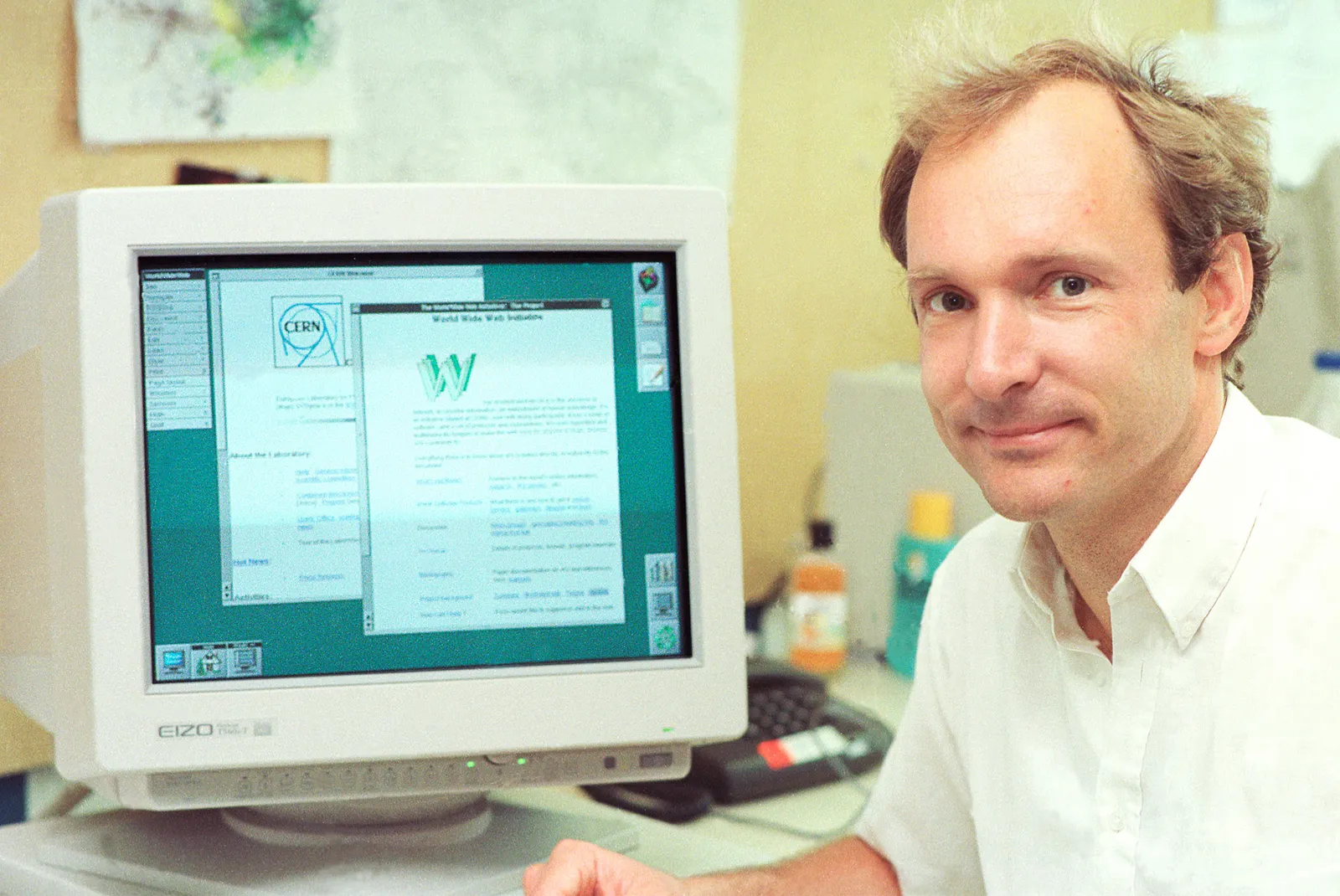
Berners-Lee at Cern, outside Geneva, Switzerland, 1994. PHOTOGRAPH © 1994–2018 CERN.
It would be nearly a decade before Berners-Lee refined the technology, renamed it, and released the Web’s source code. When it first appeared in an academic chat room, in August of 1991, the significance of the moment wasn’t immediately obvious. “No one paid much attention,” recalls Vinton Cerf, who is recognized as being a co-inventor of the Internet—atop which the Web sits—and is now chief Internet evangelist at Google. It was an information system that used an older software known as Hypertext to link to data and documents over the Internet. There were other information systems at the time. What made the Web powerful, and ultimately dominant, however, would also one day prove to be its greatest vulnerability: Berners-Lee gave it away for free; anyone with a computer and an Internet connection could not only access it but also build off it. Berners-Lee understood that the Web needed to be unfettered by patents, fees, royalties, or any other controls in order to thrive. This way, millions of innovators could design their own products to take advantage of it.
And, of course, millions did. Computer scientists and academics picked it up first, building applications that then drew others. Within a year of the Web’s release, nascent developers were already conceiving of ways to draw more and more users. From browsers to blogs to e-commerce sites, the Web’s eco-system exploded. In the beginning it was truly open, free, controlled by no one company or group. “We were in that first phase of what the Internet could do,” recalls Brewster Kahle, an early Internet pioneer who in 1996 built the original system for Alexa, later acquired by Amazon. “Tim and Vint made the system so that there could be many players that didn’t have an advantage over each other.” Berners-Lee, too, remembers the quixotism of the era. “The spirit there was very decentralized. The individual was incredibly empowered. It was all based on there being no central authority that you had to go to to ask permission,” he said. “That feeling of individual control, that empowerment, is something we’ve lost.”
The power of the Web wasn’t taken or stolen. We, collectively, by the billions, gave it away with every signed user agreement and intimate moment shared with technology. Facebook, Google, and Amazon now monopolize almost everything that happens online, from what we buy to the news we read to who we like. Along with a handful of powerful government agencies, they are able to monitor, manipulate, and spy in once unimaginable ways. Shortly after the 2016 election, Berners-Lee felt something had to change, and began methodically attempting to hack his creation. Last fall, the World Wide Web Foundation funded research to examine how Facebook’s algorithms control the news and information users receive. “Looking at the ways algorithms are feeding people news and looking at accountability for the algorithms—all of that is really important for the open Web,” he explained. By understanding these dangers, he hopes, we can collectively stop being deceived by the machine just as half the earth’s population is on board. “Crossing 50 percent is going to be a moment to pause and think,” says Berners-Lee, referring to the coming milestone. As billions more connect to the Web, he feels an increasing urgency to resolve its problems. For him this is about not just those already online but also the billions still unconnected. How much weaker and more marginalized will they become as the rest of the world leaves them behind?
We were now talking in a small, non-descript conference room, but Berners-Lee nevertheless felt called to action. Talking about this milestone, he grabbed a notebook and pen and started scribbling, slashing lines and dots and arrows across the page. He was mapping out a social graph of the computing power of the world. “This is maybe Elon Musk when he is using his most powerful computer,” said Berners-Lee, drawing a dark line at the top right of the page to illustrate the dominant position of the C.E.O. of SpaceX and Tesla. Lower on the page he scratched another mark: “These are the people in Ethiopia who have reasonable connectivity but they are totally being spied on.” The Web, which he had intended as a radical tool for democracy, was merely exacerbating the challenges of global inequality.
When about a fifth of the page was covered with lines and dots and scribbles, Berners-Lee stopped. Pointing to the space he’d left untouched, he said, “The goal is to fill in that square. To fill it up so all of humanity has total power on the Web.” His expression was intent, focused, as though he was calculating a problem for which he did not yet have the solution.
“I dumped a little code I had for doing things with email messages,” Berners-Lee typed one afternoon this spring, as he posted some code in a chat room on Gitter, an open platform frequented by coders to collaborate on ideas. It was a few days before Mark Zuckerberg was set to testify before Congress. And in this obscure part of the Web, Berners-Lee was busy working on a plan to make that testimony moot.
The forces that berners-lee unleashed nearly three decades ago are accelerating—moving in ways no one can fully predict.
The idea is simple: re-decentralize the Web. Working with a small team of developers, he spends most of his time now on Solid, a platform designed to give individuals, rather than corporations, control of their own data. “There are people working in the lab trying to imagine how the Web could be different. How society on the Web could look different. What could happen if we give people privacy and we give people control of their data,” Berners-Lee told me. “We are building a whole eco-system.” For now, the Solid technology is still new and not ready for the masses. But the vision, if it works, could radically change the existing power dynamics of the Web. The system aims to give users a platform by which they can control access to the data and content they generate on the Web. This way, users can choose how that data gets used rather than, say, Facebook and Google doing with it as they please. Solid’s code and technology is open to all—anyone with access to the Internet can come into its chat room and start coding. “One person turns up every few days. Some of them have heard about the promise of Solid, and they are driven to turn the world upside down,” he says. Part of the draw is working with an icon. For a computer scientist, coding with Berners-Lee is like playing guitar with Keith Richards. But more than just working with the inventor of the Web, these coders come because they want to join the cause. These are digital idealists, subversives, revolutionaries, and anyone else who wants to fight the centralization of the Web. For his part, working on Solid brings Berners-Lee back to the Web’s early days: “It’s under the radar, but working on it in a way puts back some of the optimism and excitement that the ‘fake news’ takes out.”

Photographs by Alfred Pasieka/Science Photo Library/Alamy (2014); From Getty Images (2001); From Hulton Archive (1971, Computer), by Pedro Ladeira/AFP (2013), Maurix/Gamma-Rapho (2016, both), Michael A. Smith/The Life Images Collection (1981), all from Getty Images; By Frank Peters/Shutterstock (1996); By Fototeca Gilardi/Superstock (1971, Worm).
It’s still the early days for Solid, but Berners-Lee is moving fast. Those who work closely with him say he has thrown himself into the project with the same vigor and determination he employed upon the Web’s inception. Popular sentiment also appears to facilitate his time frame. In India, a group of activists successfully blocked Facebook from implementing a new service that would have effectively controlled access to the Web for huge swaths of the country’s population. In Germany, one young coder built a decentralized version of Twitter called Mastodon. In France, another group created Peertube as a decentralized alternative to YouTube. “I resent the control corporations have over people and their everyday lives. I hate the surveillance society we have accidently brought upon ourselves,” says Amy Guy, a coder from Scotland who helped build a platform called ActivityPub to connect decentralized Web sites. This summer, Web activists plan to convene at the second Decentralized Web Summit, in San Francisco.
Berners-Lee is not the leader of this revolution—by definition, the decentralized Web shouldn’t have one—but he is a powerful weapon in the fight. And he fully recognizes that re-decentralizing the Web is going to be a lot harder than inventing it was in the first place. “When the Web was created, there was nobody there, no vested parties who would resist,” says Brad Burnham, a partner at Union Square Ventures, the renowned venture-capital firm, which has started investing in companies aiming to decentralize the Web. “There are entrenched and very wealthy interests who benefit from keeping the balance of control in their favor.” Billions of dollars are at stake here: Amazon, Google, and Facebook won’t give up their profits without a fight. In the first three months of 2018, even as its C.E.O. was apologizing for leaking user data, Facebook made $11.97 billion. Google made $31 billion.
For now, chastened by bad press and public outrage, tech behemoths and other corporations say they are willing to make changes to ensure privacy and protect their users. “I’m committed to getting this right,” Facebook’s Zuckerberg told Congress in April. Google recently rolled out new privacy features to Gmail which would allow users to control how their messages get forwarded, copied, downloaded, or printed. And as revelations of spying, manipulation, and other abuses emerge, more governments are pushing for change. Last year the European Union fined Google $2.7 billion for manipulating online shopping markets. This year new regulations will require it and other tech companies to ask for users’ consent for their data. In the U.S., Congress and regulators are mulling ways to check the powers of Facebook and others.
But laws written now don’t anticipate future technologies. Nor do lawmakers—many badgered by corporate lobbyists—always choose to protect individual rights. In December, lobbyists for telecom companies pushed the Federal Communications Commission to roll back net-neutrality rules, which protect equal access to the Internet. In January, the U.S. Senate voted to advance a bill that would allow the National Security Agency to continue its mass online-surveillance program. Google’s lobbyists are now working to modify rules on how companies can gather and store biometric data, such as fingerprints, iris scans, and facial-recognition images.
The forces that Berners-Lee unleashed nearly three decades ago are accelerating, moving in ways no one can fully predict. And now, as half the world joins the Web, we are at a societal inflection point: Are we headed toward an Orwellian future where a handful of corporations monitor and control our lives? Or are we on the verge of creating a better version of society online, one where the free flow of ideas and information helps cure disease, expose corruption, reverse injustices?
It’s hard to believe that anyone—even Zuckerberg—wants the 1984 version. He didn’t found Facebook to manipulate elections; Jack Dorsey and the other Twitter founders didn’t intend to give Donald Trump a digital bullhorn. And this is what makes Berners-Lee believe that this battle over our digital future can be won. As public outrage grows over the centralization of the Web, and as enlarging numbers of coders join the effort to decentralize it, he has visions of the rest of us rising up and joining him. This spring, he issued a call to arms, of sorts, to the digital public. In an open letter published on his foundation’s Web site, he wrote: “While the problems facing the web are complex and large, I think we should see them as bugs: problems with existing code and software systems that have been created by people—and can be fixed by people.”
When asked what ordinary people can do, Berners-Lee replied, “You don’t have to have any coding skills. You just have to have a heart to decide enough is enough. Get out your Magic Marker and your signboard and your broomstick. And go out on the streets.” In other words, it’s time to rise against the machines.